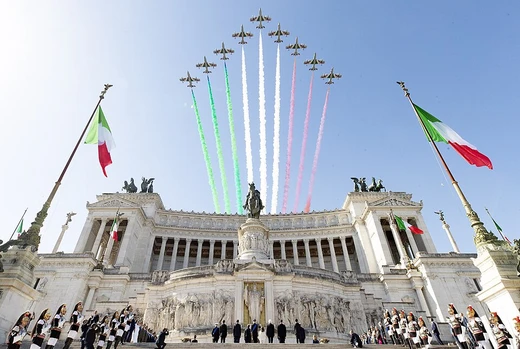
National day
A day celebrating statehood or nationhood, often a public holiday.

chensiyuan · CC BY-SA 4.0
A national day is a day on which celebrations mark the statehood or nationhood of a state or its people. It may be the date of independence, of becoming a republic, of becoming a federation, or a significant date for a patron saint, a ruler (such as a birthday, accession, or removal) or a date in that country's particular history. The national day is often an official public holiday. Many countries have more than one national day. While Denmark and the United Kingdom are sometimes cited as lacking a single official national day, both have widely recognized de facto national days: the United Kingdom has multiple, such as the King's Official Birthday and St George's Day, while Denmark observes Constitution Day (Grundlovsdag) on June 5, an official flag-flying day and a widely observed celebration of nationhood. National days emerged with the age of nationalism, with most appearing during the 19th and 20th centuries. National day may also be known as Independence Day, Liberation Day, or Republic Day, depending on the nation, and its history.
- definition
- A day marking statehood or nationhood
- common names
- Independence Day, Liberation Day, Republic Day
- countries without
- No countries are entirely without; Denmark and the United Kingdom have de facto national days
- era of emergence
- Age of nationalism, 19th and 20th centuries
- typical status
- Official public holiday
Lore & Background
A national day is a day on which celebrations mark the statehood or nationhood of a state or its people. It may be the date of independence, of becoming a republic, of becoming a federation, or a significant date for a patron saint, a ruler (such as a birthday, accession, or removal) or a date in that country's particular history. The national day is often an official public holiday. Many countries have more than one national day. While Denmark and the United Kingdom are sometimes cited as lacking a single official national day, both have widely recognized de facto national days: the United Kingdom has multiple, such as the King's Official Birthday and St George's Day, while Denmark observes Constitution Day (Grundlovsdag) on June 5, an official flag-flying day and a widely observed celebration of nationhood. National days emerged with the age of nationalism, with most appearing during the 19th and 20th centuries. National day may also be known as Independence Day, Liberation Day, or Republic Day, depending on the nation, and its history.
Reader's Guide
The national day serves as a focal point for collective identity, marking a key event in a country's history such as independence, federation, or the accession of a ruler. Its emergence during the 19th and 20th centuries reflects the rise of nationalism. While most nations observe a national day as an official public holiday, Denmark and the United Kingdom are exceptions: Denmark has an unofficial celebration called Constitution Day, and the United Kingdom has no national day at all. The term may vary—Independence Day, Liberation Day, or Republic Day—depending on the nation's specific historical path. The concept is broad enough to include dates tied to patron saints or rulers, and some countries recognize multiple national days.
Did You Know?
- Denmark and the United Kingdom are often said to lack a single official national day, but both have widely recognized de facto national days.
- Denmark's Constitution Day (Grundlovsdag) on June 5 is an official flag-flying day and a widely observed celebration of nationhood, not an unofficial event.
- National days emerged with the age of nationalism, mostly during the 19th and 20th centuries.
- A national day may also be known as Independence Day, Liberation Day, or Republic Day.
A Multi-Layered Regulatory Architecture
Thailand's public holiday system operates through distinct regulatory channels that create a layered landscape of observance. The government sets the baseline with nineteen annual holidays approved by the cabinet, and all government agencies are obligated to observe them in full. The Bank of Thailand maintains its own separate schedule for financial institutions, which typically diverges from the government list—banks skip the Royal Ploughing Ceremony and the start of Vassa, but add National Labour Day on May 1. Private employers face a different framework entirely: the Labour Protection Act mandates a minimum of thirteen holidays per year, including National Labour Day, while leaving the remaining observances to corporate discretion. Additionally, when a designated holiday lands on a weekend, the government grants a compensatory workday off to ensure employees are not disadvantaged. This multi-tiered structure means that a single calendar date can carry different meanings depending on whether one works in a ministry, a bank, or a private firm, and the total number of days off can vary by sector even within the same week.
Royal Mourning and the Reshaping of the Calendar
The death of King Bhumibol Adulyadej in 2016 triggered a significant restructuring of Thailand's holiday calendar. In April 2017, the cabinet revised the annual list, temporarily removing Coronation Day, which had long been observed on May 5. Two new public holidays were introduced to honor the royal family: July 28, marking the birthday of King Maha Vajiralongkorn, and October 13, commemorating the anniversary of King Bhumibol's passing. The total count of annual public holidays rose from sixteen to nineteen. Coronation Day was not permanently abolished but rather paused; it returned to the calendar in 2020 on a new date, May 4, chosen to serve as a shared anniversary of both King Bhumibol's coronation in 1950 and King Vajiralongkorn's in 2019. This sequence of changes illustrates how deeply the monarchy is woven into the nation's civic rhythm, with the calendar itself serving as a living record of royal succession and collective mourning.
Lunar Timers and Regional Pluralism
A notable feature of Thailand's holiday system is its reliance on the Thai lunar calendar for several key dates, meaning the Gregorian month in which they fall shifts from year to year, and in lunar leap years they slip an entire month later. Buddhist holidays carry a specific legal restriction: the sale of alcohol is prohibited nationwide, with the sole exception of international airport duty-free shops. Beyond the national framework, Thailand's holiday landscape reflects its ethnic and religious diversity, particularly in the southern provinces of Narathiwat, Pattani, Yala, and Satun. In these areas, government agencies and financial institutions also observe Chinese New Year, Eid ul-Fitr, and Eid al-Adha as official holidays, provided they do not coincide with a weekend or existing holiday. Certain ministries add their own observances—defence and education departments may mark Thai Armed Forces Day on January 18 and Teachers' Day on January 16, respectively—further illustrating how the national calendar accommodates sector-specific and regional identities within a unified system.
The Evolving Bank Holiday and Sector-Specific Exceptions
The distinction between government holidays and bank holidays in Thailand is a matter of practical consequence for millions of workers and savers. The Bank of Thailand governs the financial sector's schedule, and its list has not been static. Until 2018, a mid-year bank holiday fell on July 1, provided that date did not land on a weekend; this observance has since been discontinued. Banks also differ from government offices in their treatment of specific religious and ceremonial days: the Royal Ploughing Ceremony and the beginning of Vassa are not bank holidays, whereas National Labour Day on May 1 is. Prior to 2007, the financial sector observed the beginning of Vassa as a holiday rather than Asalha Puja, showing that even within a single regulatory body, the calendar has shifted over time. In the four southern provinces, financial institutions extend their holiday list to include Chinese New Year and the two major Islamic festivals, ensuring that workers in those communities receive equivalent time off. This patchwork of sector-specific rules means that the official holiday calendar is, in practice, a mosaic of overlapping and divergent schedules.
Gallery





Frequently Asked Questions
What exactly is a national day?
A national day is a commemorative date that marks a country's statehood or the collective identity of its people. It typically falls on a milestone such as independence, the founding of a republic, or the anniversary of a significant historical figure.
When did the concept of national days first appear?
National days largely emerged during the Age of nationalism in the 19th and 20th centuries, as newly formed or reformed states sought to anchor their shared identity around a specific calendar date.
Do all countries have a national day?
Every country effectively has one, though Denmark and the United Kingdom are sometimes noted for lacking a single codified official national day. Both nonetheless celebrate widely recognized de facto national days that function in practice the same way.
What are the most common names for a national day?
Depending on the historical event being honored, a national day is often called Independence Day, Liberation Day, or Republic Day. Some countries also mark the birthday or accession of a monarch as their primary national celebration.
Is a national day always an official public holiday?
While a national day is very often designated as an official public holiday, the term itself refers to the commemorative date rather than its legal status. Many countries observe multiple national days, and not every one carries the same level of statutory holiday recognition.
More in Public Holidays & Observances 1-24
Elsewhere in the Public Holidays & Observances universe
Spotted an error? Know more?
This is a living reference — every entry is fact-audited, and reader corrections feed straight into our audit queue. Suggest an edit · See this site's audit record